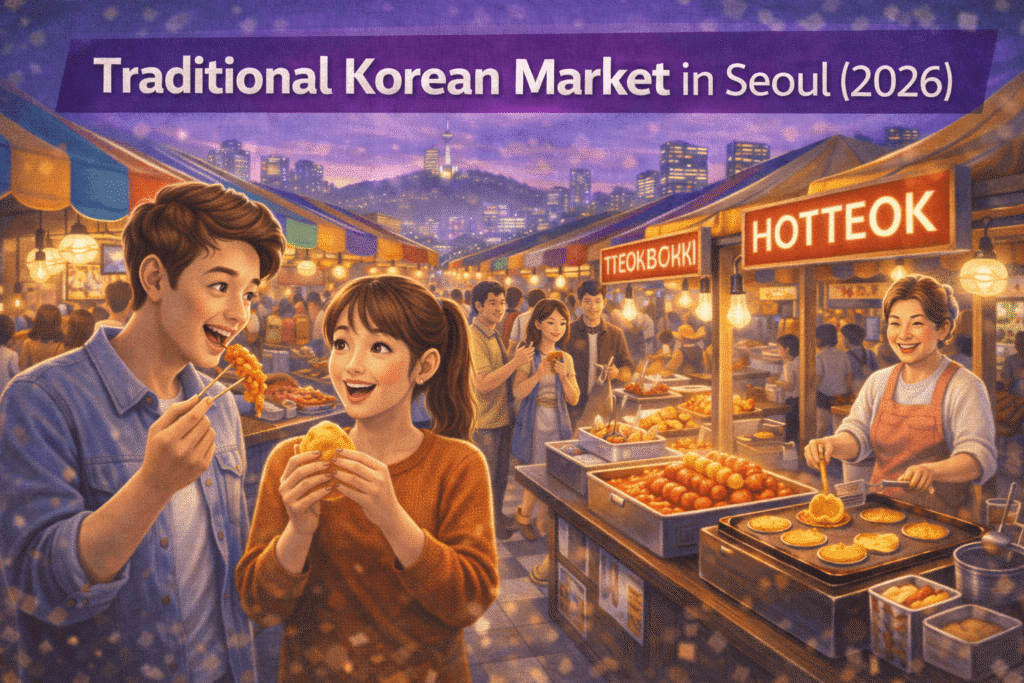
Traditional markets in seoul are not frozen in time.
They’re modernizing fast. Card terminals are everywhere. Government support has pushed digital payments hard.
But here’s the reality:
It’s not consistent.
Some vendors happily tap your Visa.
Some prefer cash during busy hours.
Some point to a QR code for Korean bank transfers that you absolutely cannot use.
For foreign visitors, that in-between phase is the most confusing part.
So this guide focuses on what actually matters:
- 💳 Where cards usually work (and where they don’t)
- 🚇 Exact subway exits (no wandering)
- ⚠️ What to avoid
- 💵 How much cash to carry
- 📍 What to do nearby
💳 The 2026 Payment Reality: Is It Really Cash Only?
Short answer:
No — but cash is still the stress-free king.
Thanks to modernization programs, many traditional markets now have card terminals. However, your experience depends on the type of stall.
✔️ Permanent Stalls (Roof + Sign + Seating)
- Most accept international cards (Visa / Mastercard).
- Especially true inside buildings and food alleys.
⚖️ Small Snack Vendors (2,000–5,000 KRW Items)
- Many can take cards.
- Some may refuse small-amount transactions.
- During peak hours, machines “suddenly stop working.”
🚫 The Bank Transfer Trap (계좌이체)
You’ll see QR codes everywhere.
Ignore them.
They are for locals using Korean banking apps.
For you, it’s either card or cash.
💡 Pro Tip
If the stall looks permanent, try your card first.
If it’s a temporary cart in the middle of the walkway, have 10,000 KRW bills ready.
Carrying 20,000–30,000 KRW in cash removes almost all stress.
1️⃣ Gwangjang Market
If you have only one traditional market meal in Seoul, make it here.
Order bindaetteok.
Add makgeolli.
Accept the noise.
That chaos is the charm.
🚇 How to Get There
Jongno 5-ga Station (Line 1) → Exit 8
You walk straight into the market. No maze.
💳 2026 Payment Update
Card terminals are now common in the central food alley.
However:
- Busy hours = vendors prefer fast cash.
- Some stalls may claim “machine error” when lines are long.
- Indoor restaurants along outer buildings almost always accept cards.
Best strategy: mix card + cash.
⚠️ Don’t Do This
You’ll be tempted to film everything for TikTok.
But remember: these aisles are the vendors’ highways.
Don’t be the tourist who causes a human traffic jam.
Also:
- Famous Netflix kalguksu stall? 30+ minute waits on weekends.
- See a massive line? Walk 10 meters. Similar food. Less hype.
🌙 After You Eat
Walk 3 minutes to
Cheonggyecheon Stream
Market chaos → calm night lights → digestion walk.
It’s the classic local follow-up route.
If you’re visiting after dark and wondering about safety, see Is Seoul Safe at Night? (2026 Safety Guide for Tourists) for realistic guidance.
🟨 Real Insider Tip
Weekday before 6PM is dramatically calmer than Saturday 8PM.
2️⃣ Tongin Market
Smaller. Interactive. Best for daytime.
🚇 Access
Gyeongbokgung Station (Line 3) → Exit 2
10-minute walk.
💳 Payment Reality
The famous Dosirak Cafe coin system = cash only.
Outside that experience, many vendors accept cards.
⚠️ Timing Warning
The Dosirak Cafe usually closes around 4–5PM.
Arrive late and you’ll miss the main attraction.
🟨 Real Insider Tip
Buy small portions first. The famous gireum tteokbokki is oily and not for everyone.
3️⃣ Namdaemun Market
Old-school Seoul energy.
Less Instagram. More wholesale.
🚇 Access
Hoehyeon Station (Line 4) → Exit 5
Also walkable from Myeongdong.
If you’re staying nearby and still deciding on accommodation zones, see Best Areas to Stay in Seoul for First-Time Visitors (2026 Guide) for comparison.
💳 Payment Reality
- Permanent shops = mostly card-friendly.
- Small outdoor tables = cash preferred.
- Prices not always clearly labeled.
Ask first. Pay second.
🟨 Real Insider Tip
If you’re staying in Myeongdong, this is the easiest traditional market to visit without complicated transfers.
4️⃣ Mangwon Market
The most modern and card-friendly traditional market in Seoul.
This is where locals actually grocery shop.
🚇 Access
Mangwon Station (Line 6) → Exit 2
Very accessible from Hongdae.
💳 Payment Reality
Highest card acceptance rate among major markets.
Still bring small cash for quick snack stalls.
🟨 Real Insider Tip
If you want a lower-stress market experience near Hongdae, this is your best option.
5️⃣ Dongmyo Flea Market
This is the exception.
If there’s one place where cards are genuinely close to useless, it’s here.
🚇 Access
Dongmyo Station (Line 1 & 6) → Exit 3
💳 Payment Reality
Outdoor clothing piles.
Elderly vendors.
No terminals.
Cash only — almost universally.
Bring small bills.
🟨 Real Insider Tip
This isn’t curated vintage. It’s digging through clothing mountains. If you find something great, it feels earned.
💵 How Much Cash Should You Carry?
Light visit:
20,000–30,000 KRW
Heavy food sampling:
40,000 KRW
Seoul is card-friendly — but traditional markets are still transition zones.
For a full payment breakdown, see:
How to Pay in Korea: Cash vs Card vs T-Money (2026 Tourist Guide)
🏆 Quick Decision Guide
| Staying In | Best Market |
|---|---|
| Myeongdong | Namdaemun / Gwangjang |
| Hongdae | Mangwon |
| Gangnam | Gwangjang |
| Seongsu | Gwangjang / Dongmyo |
Final Thoughts
Traditional markets in Seoul are not about comfort.
They’re about texture, sound, unpredictability — and a little bit of negotiation with reality.
They’re no longer fully cash-only.
But they’re not fully frictionless either.
If you carry both a card and some cash —
you’ll navigate them like someone who’s done this before.
For more official visitor information, you can also visit the Korea Tourism Organization website.