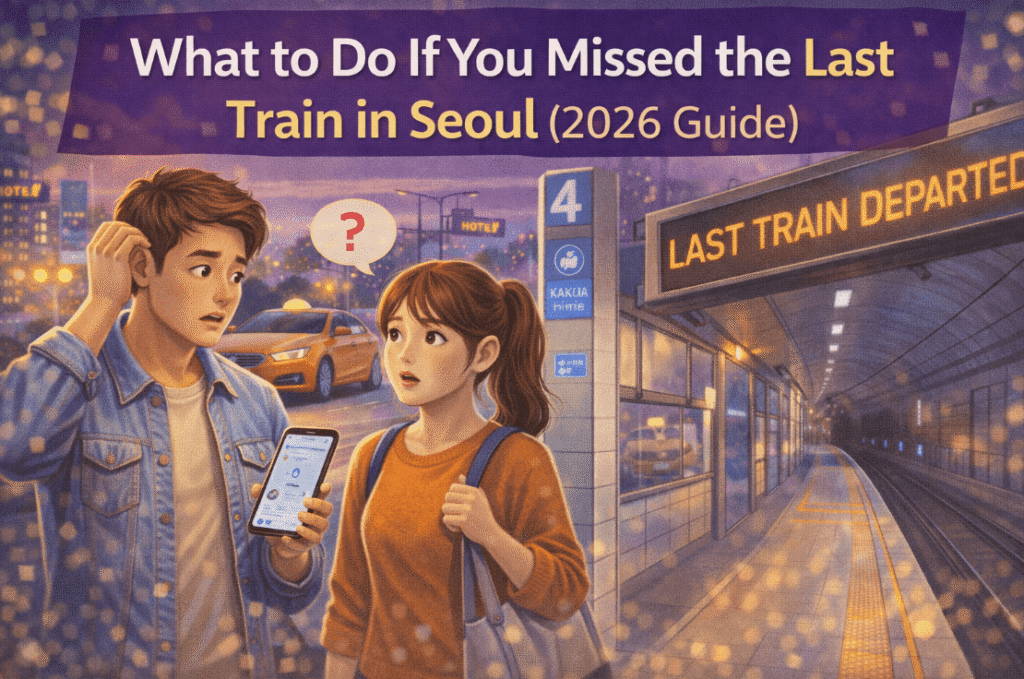
Seoul’s subway system is clean, fast, and easy to use — but it does not run 24 hours.
Most subway lines typically have their last trains departing around 11:30 PM or midnight, depending on the line and direction.
If you missed the last train in Seoul, don’t panic. The city is very safe at night, and you have several realistic options.
This guide explains exactly what to do in 2026, how much it costs, and which option makes the most sense for tourists.
How to Check the Last Train Time (막차) Before It’s Too Late
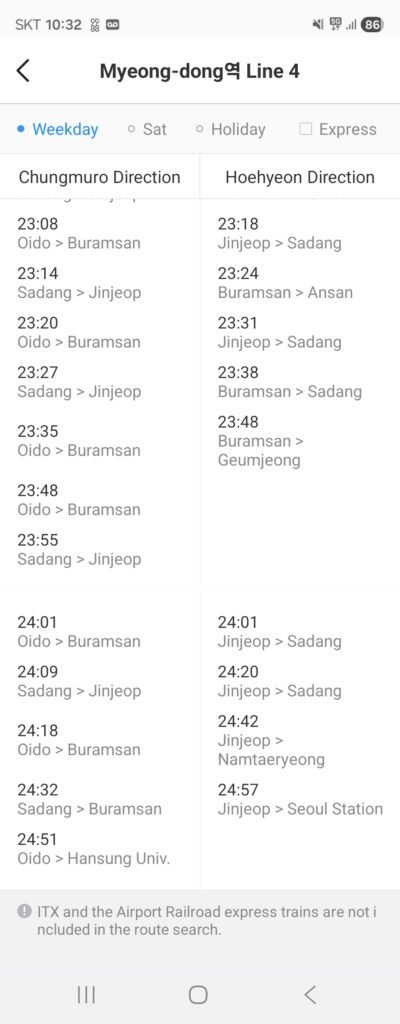
The easiest way to avoid this situation is to check the last train time before heading out for dinner or drinks.
Both Naver Map and Kakao Map show the exact final departure time for every subway route. After searching your destination, open the route details and tap the “Last Train (막차)” option to see when the final subway leaves.
Because Google Maps does not always show accurate subway transfers or last-train details in Korea, many locals rely on Naver or Kakao Map instead — something explained in detail in the comparison guide Google Maps vs Naver Map vs Kakao Map in Korea (2026 Complete Tourist Guide). If you’re using Kakao Map in English, the step-by-step breakdown in How to Use KakaoMap in English (2026 Guide) can help you find the last-train feature quickly.
First: Stay Calm — Seoul Is Extremely Safe at Night
Compared to many global cities, Seoul is considered one of the safest major capitals in the world. CCTV coverage is extensive, convenience stores operate 24/7, and nightlife districts remain active well past midnight.
If safety is your main concern, the practical breakdown in Is Seoul Safe at Night? (2026 Safety Guide for Tourists) explains what tourists should realistically expect after dark.
Option 1: Take a Taxi (Most Practical Solution)
For most travelers, taking a taxi is the simplest solution after missing the last subway.
2026 Taxi Cost Estimate
- Base fare: ₩4,800–₩5,800
- Late-night surcharge: 20–40%
- Highest surcharge window: typically 11 PM – 2 AM
- 15–20 minute ride in central Seoul: around ₩12,000–₩25,000
Longer cross-city rides can cost more, but taxis are still relatively affordable compared to many Western cities.
How to Call a Taxi
You have three main options:
- Street taxi
- Kakao T app
- Uber app
While Kakao T is the most widely used local app, some travelers find account setup or overseas card registration inconvenient. The Uber app works in Seoul and connects you to local taxis (often branded as “UT”), allowing you to use your existing international Uber account without creating a new Korean profile.
Most taxis accept foreign credit cards, though carrying some backup cash is wise — especially late at night. If you’re unsure about payment methods, the breakdown in How to Pay in Korea: Cash vs Card vs T-Money (2026 Tourist Guide) explains what works best for visitors.
Option 2: Take an N-Bus (Owl Bus)
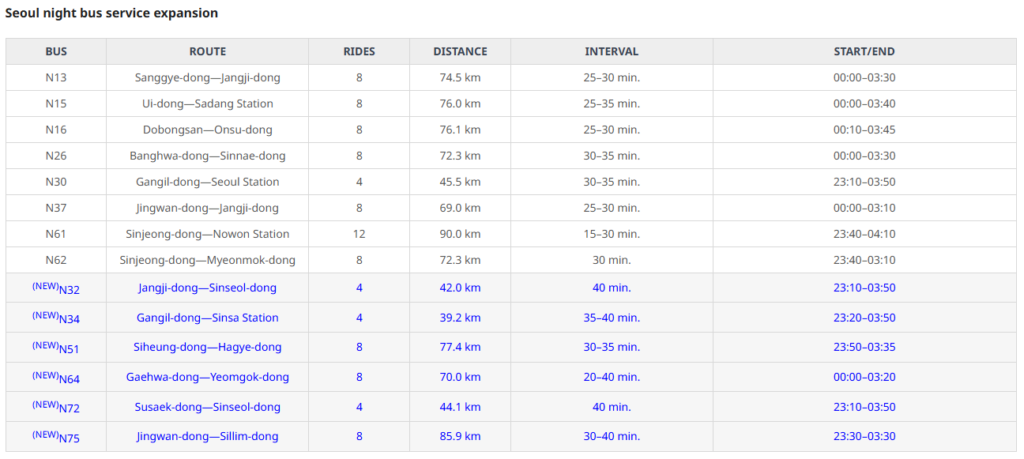
Seoul operates special late-night buses called N-Buses (올빼미 버스).
You can identify them easily: look for routes starting with the letter “N”, such as N13 or N61. These buses only run at night and connect major districts across the city.
However, there are two important things to know:
- Routes are limited compared to daytime buses.
- Frequency is usually every 30–40 minutes, so timing matters.
Always check arrival time in your map app before walking to the bus stop.
If you’re using the Seoul Climate Card for unlimited transit, it can also cover public bus routes, including night buses, which makes late-night travel significantly cheaper. The full explanation of how the pass works is covered in Seoul Climate Card (2026): The Ultimate Unlimited Transit Guide for Tourists).
Option 3: Rest at a Jjimjilbang (Korean Sauna)
If you don’t want to spend money on a taxi and prefer somewhere warm and safe to rest, search nearby for a jjimjilbang (Korean sauna).
These facilities are often open 24 hours and typically cost around ₩15,000–₩20,000 for overnight entry. They provide heated floor sleeping areas, lockers, showers, and separate bathing areas by gender.
Many budget travelers use jjimjilbangs as an emergency overnight option. It’s affordable, safe, and offers a unique cultural experience — though not all locations operate 24 hours, so check before entering.
Option 4: Wait for the First Train
Subway services usually resume around 5:00 AM.
If you’re in a busy area like Hongdae, Myeongdong, or Dongdaemun, waiting at a 24-hour convenience store or cafe is generally safe. This option is less comfortable during winter or if you’re carrying heavy luggage, but it is technically possible.
Special Case: Trying to Reach the Airport
If you missed the last train while trying to reach Incheon Airport, your choices become more limited.
Late-night airport buses operate on selected routes, but taxis to Incheon typically cost ₩60,000–₩90,000, depending on distance and surcharge timing. Travel time is usually 50–70 minutes without heavy traffic.
If you’re planning airport transfers in advance, the detailed breakdown in How to Get from Incheon Airport to Hongdae (2026 Complete Local Guide) and the comparison in AREX Express vs All-Stop Train: Which One Is Better for You? explain daytime transport options more clearly.
Smart Prevention Tips
- Check the “Last Train (막차)” time before dinner
- Screenshot your return route
- Keep at least ₩20,000 for emergencies
- Install both Kakao T and Uber before going out
- Avoid relying solely on Google Maps for subway timing
FAQ
Is it safe to take a taxi alone at night in Seoul?
Yes. Taxis are regulated and generally very safe.
Can I sleep inside subway stations?
No. Stations close after the last train.
Do taxis accept foreign credit cards?
Most do, but carry backup cash just in case.
Is Uber available in Seoul?
Yes. The Uber app connects you to local taxis (often called UT taxis) using your existing account.
For more official travel information, visit the Korea Tourism Organization website.